Web Design is 95% Typography
95% of the information on the web is written language. It is only logical to say that a web designer should get good training in the main discipline of shaping written information, in other words: Typography.
Information design is typography
Back in 1969, Emil Ruder, a famous Swiss typographer, wrote on behalf of his contemporary print materials what we could easily say about our contemporary websites:
Today we are inundated with such an immense flood of printed matter that the value of the individual work has depreciated, for our harassed contemporaries simply cannot take everything that is printed today. It is the typographer’s task to divide up and organize and interpret this mass of printed matter in such a way that the reader will have a good chance of finding what is of interest to him.
With some imagination (replace print with online) this sounds like the job description of an information designer. It is the information designer’s task “to divide up and organize and interpret this mass of printed matter in such a way that the reader will have a good chance of finding what is of interest to him”.
Macro-typography (overall text-structure) in contrast to micro typography (detailed aspects of type and spacing) covers many aspects of what we nowadays call “information design”. So to speak, information designers nowadays do the job that typographers did 30 years ago:
Typography has one plain duty before it and that is to convey information in writing. No argument or consideration can absolve typography from this duty. A printed work which cannot be read becomes a product without purpose.
Optimizing typography is optimizing readability, accessibility, usability(!), overall graphic balance. Organizing blocks of text and combining them with pictures, isn’t that what graphic designers, usability specialists, information architects do? So why is it such a neglected topic?
Too few fonts? Resolution too low?
The main—usually whiny—argument against typographical discipline online is that there are only few fonts available. The second argument is that the screen resolution is too low, which makes it hard to read pixelated or anti-aliased fonts in the first place.
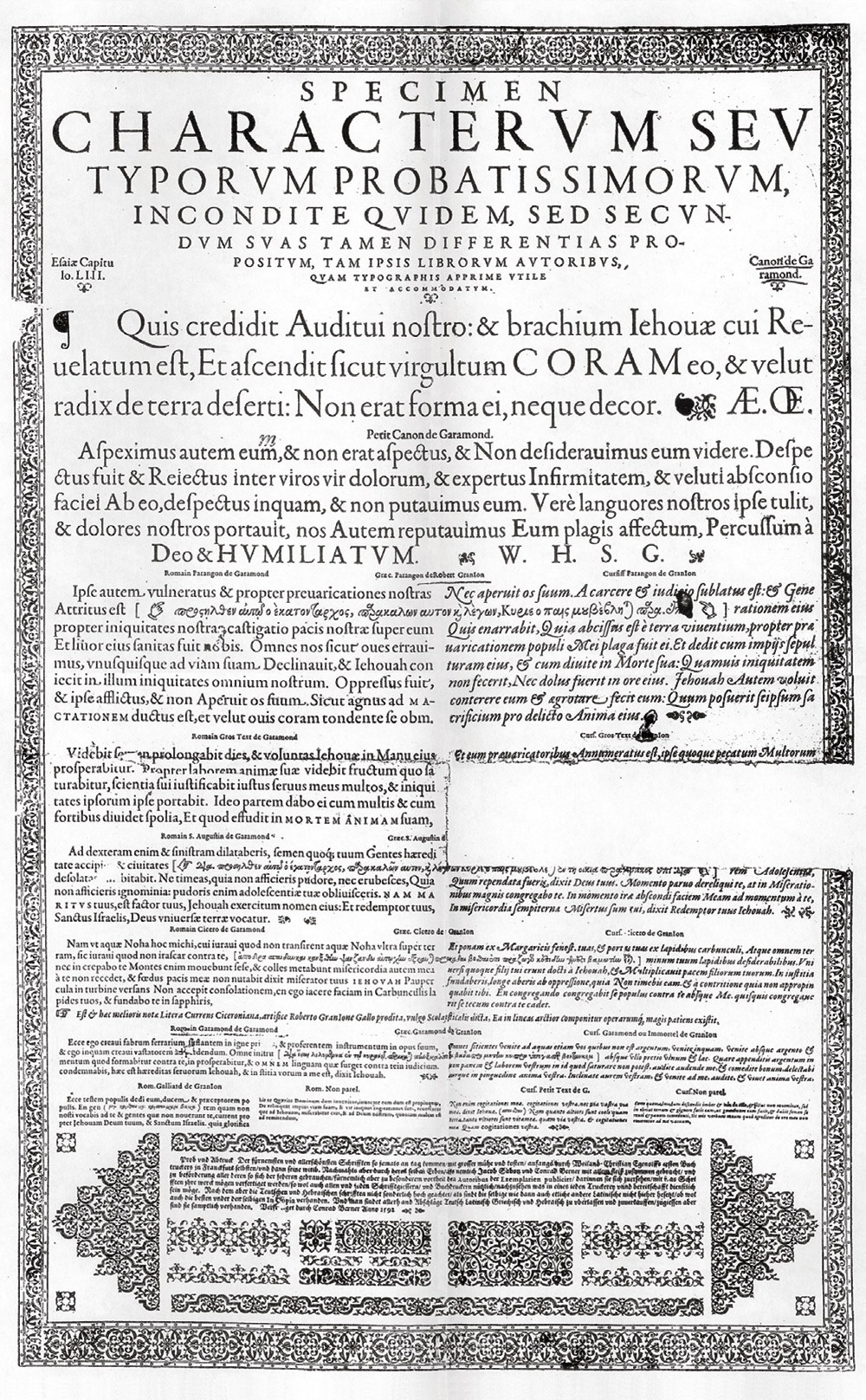
The argument that we do not have enough fonts at our disposition is as good as irrelevant: During the Italian renaissance the typographer had one font to work with, and yet this period produced some of the most beautiful typographical work:

The typographer shouldn’t care too much what kind of fonts he has at his disposal. Actually the choice of fonts shouldn’t be his major concern. He should use what is available at the time and use it the best he can.
Choosing a typeface is not typography
The second argument is not much better. In the beginning of printing the quality of printed letters was way worse than what we see on the screen nowadays. More importantly, if handled professionally, screen fonts are pretty well readable.
Information design is not about the use of good typefaces, it is about the use of good typography. Which is a huge difference. Anyone can use typefaces, some can choose good typefaces, but only few master typography.
Treat text as a user interface
Yes, it is annoying how different browsers and platforms render fonts, and yes, the resolution issue makes it hard to stay focused for more than five minutes. But, well, it is part of a web designer’s job to make sure that texts are easy and nice to read on all major browsers and platforms. Correct leading, word and letter spacing, active white space, and dosed use of color help readability. But that’s not quite it. A great web designer knows how to work with text not just as content, he treats “text as a user interface”. Have a look at Khoi Vinh’s website, and you’ll probably understand what that means:

Slightly more famous examples of unornamental websites that treat text as interface are: google, ebay, craigslist, youtube, flickr, Digg, reddit, delicious. Being a hard to dispute necessity, treating text as a user interface is the only parameter for success. Successful websites manage to create a simple interface AND a strong identity at the same time. But that’s another subject.
UPDATE: As it raised so many eyebrows, hands and questions I decided to write a follow up to this article.
Where to start: Resources
On the Web
- Web typography In order to “allay some of the myths surrounding typography on the web”, he has “structured his website to step through Bringhurst’s working principles, explaining how to accomplish each using techniques available in HTML and CSS”.
- Five simple steps to better typography The kind of typography he is talking about “is not your typical ‘What font should I use’ typography.” A good read for those who believe websites are usable when leaving font size and line spacing to default while letting the text width expand to wherever.
- Khoi Vinh Co-founder of behaviordesign. Currently design director at NYTimes.com. Extremely talented man.
- Rod Graves Communication designer. Sublime work: “Typography is a definite focus for me. Typographic grids and hierarchies usually form the foundation of the visual languages I develop.”
- A List Apart Communicating via typefaces. Fonts and layout. Designing for readers. Legibility. Typefaces, graphic design. Problems of typography on the web. Controlling web typography: size, font, color. CSS methods, browser problems, user problems, and workarounds. Make sure you read this article as well.
- Association Typographique Internationale ATypI (Association Typographique Internationale) is the premier worldwide organisation dedicated to type and typography. Founded in 1957, ATypI provides the structure for communication, information and action amongst the international type community.
- Thinking with Type The on-line companion to the book Thinking with Type: A Critical Guide for Designers, Writers, Editors, & Students
- Typetester Compare screen type
- Typophile Typophile is a member and sponsor-supported community. Since 2000 Typophile has been guided by open collaboration and the idea that we’re all always learning. We they serve 3+ million pages monthly.
- Typohile Wiki A user-created encyclopedia of all things type and design-related. Users create and edit Wiki entries with the aim of becoming a collaborative, useful, balanced and relevant resource.
- The Next Big Thing in Online Type Bill Gates wants computer users, well, Microsoft users, to have a more enjoyable on-screen reading experience — so much so that he made improving reading on the screen one of his top five priorities.
Books
- Emil Ruder, Typographie Emil Ruder’s Typography is the timeless textbook from which generations of typographer and graphic designers have learned their fundamentals. Ruder, one of the great twentieth-century typographers was a pioneer who abandoned the conventional rules of his discipline and replaced them with new rules that satisfied the requirements of his new typography.
- Kimberly Elam, Grid Systems: Principles of Organizing Type Although grid systems are the foundation for almost all typographic design, they are often associated with rigid, formulaic solutions. However, the belief that all great design is nonetheless based on grid systems (even if only subverted ones) suggests that few designers truly understand the complexities and potential riches of grid composition.
- Muller-Brockman, Grid Systems: A visual communication manual for graphic designers, typographers and three dimensional designers. From a professional for professionals, here is the definitive word on using grid systems in graphic design. Though Muller-Brockman first presented hi interpretation of grid in 1961, this text is still useful today for anyone working in the latest computer-assisted design.


Ninety-five percent, huh? Yeah, that’s probably true — for this particular website.
I personally find it quite amusing you’ve got a typo in a article about the importance of proper text and formatting. :p
Yeah, I’m sorry about typos. I’m Swiss, and those are a little bit harder to see for my German eyes. I know I should spell check it in Word or something…
Thomas: It appears to be true for your website as well ;)
I personally find it quite amusing that Ed has a typo in his comment on the article about the importance of proper text and formatting. :p
It is practice for some of us to set the default font in our browser to a text size that we find comfortable to read. All of the text on this page is (in my browser at least) set in a font that overrides my preferred text size to a font size several sizes smaller, making the entire page uncomfortable to read. The question for you I suppose is whether there is a way for you to overcome this while at the same time maintaining the admirable elegance of your page presentation.
I agree with you on importance of typography - i studied it in uni, practice it everyday and honestly feel pretty humbled by it - and it sure can be fun.
…but the arguement that there are enough web fonts is a bit grating - microsoft, with its 1996 release of core web fonts, essentially dicated the ~8 faces we use to this day - as new fonts in the hands of web typographers could revitalize the webscape.
Funny enough MS has stopped freely distributing this core set.
Speaking of real annoyances - not trying flame - this sort of thing is what gets to me… collisions, oh my!
Oliver: Touché. Maybe you’re on to something. ;)
So a completely inaccessible website that only works in IE6.0, has horribly optimised images, a nasty colour scheme, and confusing layout will do fine as long as it’s typography is good? I might disagree.
You equate typography to the broad topic of “written language,” and if I accept that, I agree with the “95%” statement. Then, you equate typographers to information architects, both as the people who “divide up and organize and interpret this mass of printed matter in such a way that the reader will have a good chance of finding what is of interest to him.” When I read the quote, I thought: Google. So, I can agree there, “typograpy” as you have defined it, is very important to web design.
But the second half of your post abandons your comparisons to information architecture and language, and focuses solely on fonts. Sorry, web design is not 95% font selection.
“The main discipline of shaping written information” I would say that’s grammar and style, not fonts.
Regarding fonts on the web, I always surf with the “allow pages to choose their own fonts” option turned OFF. That shields me from the bad typography decisions of “web designers” who want web design to be just as controllable as design for print or television. I guess I’m more interested in that unremarkable 5%… content, interactivity, all the unique benefits of hypermedia (clickable links), searchability, organization, prose, etc., etc.
For me, the best-designed websites are the ones which don’t explode when I force them to display their content in something that I feel comfortable reading.
Typography (as font selection) is a great art, and a good typographer can produce some beautiful work. However, giving aspiring “web designers” the idea that they know better than the user does is wrongheaded. It breeds the kind of designer who builds their entire site in Flash so that they may override my overrides.
I hope you find this criticism constructive or useful in some way.
Hmm, if we’re taking basic design elements, I’d say it’s more 95% (if not more) grids, not typography.
I personally disagree with this article. Web design is 95% Design, Usability, Accessibility and Testing. Then you choose wether Verdana, Arial, Times or maybe Georgia should be used for body copy. Nice one for collating the resources though.
Dan: a “completely inaccessible website that only works in IE6.0, has horribly optimised images, a nasty colour scheme, and confusing layout” will not “do fine as long as it’s typography is good” because “nasty colour scheme, and confusing layout” IS bad typography.
And of course someone with an eye for typography will not miss out on the simple tasks like optimizing his pictures.
Mike: “The main discipline of shaping written information I would say that’s grammar and style, not fonts.”
Yeah, but that’s not design, that’s writing. Writing is shaping information from within. Typography is shaping information optically.
That you turned the option for “allow pages to choose their own fonts” off is fine with me. But most users actually have it turned on.
So is the default font size: Usually not defined by the user, but by the designer. Which is not such a bad thing, if you think about it. As much as I prefer a pilot flying my plane, a hairdresser cutting my hair, a shoemaker making my shoes, I prefer a designer defining typography. It is a profession as much and as useful as being a pilot, hairdresser, shoe maker.
Good designers do actually know more than your usual hairdresser, pilot or shoemaker, which typography works and which doesn’t. Now if the hairdresser, pilot shoemaker prefers to use his own settings, fair enough. But he should not impose on other people that enjoy a designers work.
Usability is a utilitarian discipline. Biggest use for biggest number. Fortunately, people that turn off their “allow pages to choose their own fonts” option are in the minority. They do suffer from bad design decisions, but they profit from good design decisions as well.
Tom:
Isn’t usability optimization a form of typography: Rearanging blocks of text so they’re placed in a way that they’re understood as they’re intended?
Brilliant article. And a good example at the same time.
While I really disliked the overall feel and readability of the left sided subheadings I must say that the title was catchy enough that I put up with them.
Overall the article itself is rather bland making only a few points and not developing them as much as I’d like, but the resource list is excellent so this pieces makes for a rather nice experience.
Thanks, Gamermk.
The leftsided subheadings are not leftsided subheadings, they’re more like sidecomments. Reading help. An additional scan option. A way to read the article in 5 seconds.
I am happy to hear you want to read more on the subject. I wanted to keep this short, because in general those blog entries (mine too) are just too long.
I am planning to do a follow up on typographic grids and whitespace…
Well said. Content is what drives traffic, not graphics, therefor, typography should be any web designer’s primary concern.
For those that are irritated by a designer defining a font in a size too small to read that’s why we can adjust font-size by hitting a button or a key combo. And, if the designer has done their job well then everything will scale perfectly.
Some of you seem to be confusing what a well designed site is. If a design falls to pieces when you scale the font size then it’s not a good design. Part of typography for the web is understanding that and making the accommodation.
Eh, why are some people here saying that they disagree with the article because web design is not about picking fonts? Apparently you did not read it at all… I agree with the author; web design is not about typefaces, it’s about typography.
Yes. And, unfortunately, many so-called web designers spend 95 percent of their time on the other 5 percent.
[...] Web Design Is 95% Typography [...]
I like pretty pictures
I find typography one of the most frustrating parts of dealing with differences between operating systems and computers. Type is displayed so beautifully on my machine, and yet looks so terrible on your typical PC that I can’t help but cringe. The readability is noticeably poorer on a machine with a less powerful graphics card, which is unfortunate, but being aware of that fact is so important.
I am soon to graduate from the same school from which Rod Graves graduated this year. I’m excited you included him in your list.
This article and accompanying resources will be invaluable to my grad project! I greatly admire the use of space and the alternative (more print-like) ways of displaying the information that is found on every blog (and usually in a limited number of ways).
I think in my last project that typography and readability issues comprised about 75%, but that may even be underestimated.
In other words: Crafting good illustrations, making easily understandable graphs, designing a coherent behavior, making good use of whitespace, et cetera is only 5% in a world where we have digital typefaces with auto-kerning?
Consider me confused.
Niklas: Again, looking at your website, I am confused that you’re confused: It’s 95% text. Also: From where I come from (Basel), use of whitespace, defining the (text)grid IS a typographical issue. But maybe that’s a Swiss thing. Yet crafting good illustrations is as much web design as taking good pictures with a camera.
People keep relating to the remaining 5%. Okay then: What kind of picture you choose, where you put them in the grid, or what exact spacing you use for your grids - it’s a matter of taste. So here is my equation: 95% typography, 5% taste.
And don’t think taste is just a personal random thing. There are people with good taste, there are people with bad taste, there are people with trained taste and people with potential and people without potential.
Design is no different from wine: Eventhough everybody is entitled to have his own taste and opinion - some people just have better taste, just have a trained nose for things.
You might call me elitist. Personally, I don’t believe my taste is too special for that matter. Yet I know that I understand better how websites should look than your average shoemaker, pilot or hairdresser. Which is not elitist but just plain common sense, as making websites is my profession.
Then again, it all depends. If you do a website all by yourself you probably need to be a webdesigner, ia, usability consultant, photographer, illustrator, programmer etc all in one. Making a website is not 95% typography, designing it is. My point: You need more typographical skills to do a website than doing a party flyer. Which is kind of paradox, as you have very restricted typograhical freedom on the web. Of course the flyer is only nice if you know about typography, but it still works. Websites simply really don’t.
Oliver, When I design something. Anything. I consider:
Then I do the practical aspect of design: Drawing, laying out whitespace etc. If I did point 1 through 5 correct I don’t need to spend much time doing the practical aspect.
But maybe we are not too different in our opinions after all. I just realised that maybe you are trying to equate typography with design. Could that be at least part of the subject?
Niklas: Like you said. We’re not too different. I think the misunderstanding comes from the use of “web design”.
“Web design” as the “process of producing a website” obviously needs much more than the ability to treat text as an interface. “Web design” as the part of the process where you shape the interface, almost equates to typography. Hence 95%.
The rest is taste. What pictures, colors, boxshapes etc you choose.
Excellent.
Type as interface. Such an obvious idea. So obvious everywhere. Google. Etcetera. Yet it’s obviousness is only articulated by some, i.e. I.A.
Perhaps the importance of Typography to the web stems also from the idea that it’s too difficult to create useable graphical sites? Low resolution and browser issues impact graphics and other visual media more than text. In other words, online text is limited but online graphics more so.
Whether Typography is 95%, 96%, 97% of web design is not important. What is important is that it is bloody important.
what about the widow in the first paragraph?
atley: Yeah, widows are hard to deal with, if site and fonts are scalable ; ). But I guess a real master might have a CSS solution for that.
As iA will upgrade soon (from Ltd. to Inc. = KK in Japan) I have a little design upgrade in mind. I am actually experimenting with a new, smarter layout, with a 100% font size default, that will shake the foundations of webdesign ; ). Right now there is not much difference there. Until then, I’ll stick with my current bricolage solution (Measure width 50%).
UPDATE: I just integrated this bigger font size for test purposes. Tell me what you think.
UPDATE: New smarter layout is in place. And it rocks. Thanks to my uberreader.
“Oliver: Isn’t usability optimization a form of typography: Rearanging blocks of text so they’re placed in a way that they’re understood as they’re intended?”
I don’t think so, you seem to be confusing it with Information Architecture? Web fonts are too limited to be considered that important, even in Graphic Design where there are no limits to typography I’d say it was perhaps 50% of the problem.
Tom: “Information presented with clear and logically set out titles, subtitles, text, illustrations and captions will not be only read more quickly and easily but the information will also be better understood and retained in the memory. This is a scientifically proven fact and the designer should bear it constantly in mind.”
Muller-Brockman, Grid Systems A visual communication manual for graphic designers, typographers and three dimensional designers. Basel, 1981, p.13.
Idea: petition a couple font companies to release 1 font to the public domain.
Get all the alternative browsers developers to -embed- those fonts into their browsers (like fonts get embedded into flash files) so it doesn’t matter if the user has the font installed or not.
Oliver, you got me thinking about this issue…
Especially regarding the usability topic, Tom has a point, choosing behavior and content, problem definition and problem framing. Rather, typography fits nicely in as the process of optimizing representation, visibility, readability and, especially, information presentation.
If the history books are written by the winners, the present is written by the press. In this specialized field, our primary news media is the blogosphere; a medium where the writer is almost always the designer, a medium whose format is in its primordial stages. The kings in this age are the rockstar design bloggers, who see themselves as typographic savants because they labour, day in and day out, adding to and editing their personal typographic super-column one page (sometimes more) consisting of one large column of type that goes down and down and down, usually center-aligned, fixed-width, on a solid-color background. So much for design magazines.
As today’s purveyors of design news, the designer-bloggers, having no editors to please, write about their own interests. Since their blog is their main hobby, it is their main interest in and of itself. And since they design for clients much in the same way they design for themselves, their understanding of web design problems is as bare bones as the design of their blog, which is also manifested in the blog-like websites their sell to their clients. But since the rest of us, who spend our days not writing about web design, but actually doing it, don’t have blogs and don’t shape the current web design discourse, our real issues are left un-debated and un-acknowledged.
The truth is, 95% of the work of web designers doesn’t look, work or read like a blog. Blogs purvey writing, but a designer’s typical client’s website doesn’t. Rather, they sell a product of a service, and type is only one of the many elements employed to communicate its value. Blogs don’t share that burden, and so their design problem is reduced to one of pure typography. But all those real issues that designers deal with are site-unseen for the designer-bloggers, and so they go un-debated. If there is one exception, it is Design Observer, which does debate real design issues, but it is by far a minority in the current blog landscape.
Some day, this will change. It did before. There was a time when the likes of Benjamin Franklin wrote, edited, and typeset their own newspapers. After them, there were designers like Tschichold who mastered page layout. Eventually, there were designers who built upon those former masters to such an extent that their work transcended the boundaries imposed upon them by their means of production. Those designers created work whose primary focus was communication. It is the work of the likes of Paul Rand, Saul Bass, Massimo Vignelli, et al. and it connects with people beyond well-formed typography.
All we designers can do today is keep pushing the limits to ensure that the tools mature, and to encourage the medium to grow out of its current larval stage. In the meantime, we’ll just have to keep enduring articles like this one.
Well, Justin. Eventhough you have a lot to say, I don’t know where exactly you disagree with me, but I am certainly looking forward to the day when I can see your work if you’re the new Paul Rand, Saul Bass, Massimo Vignelli of the web. We certainly all admire their work.
Until that day, I keep checking up on people like Khoi Vinh, while doing my job as good as I can. If you feel like expressing yourself more, you’re free to express your views here at any time. Generally I approve all comments, as long as they’re polite and there is something relevant in them. You might also think about starting a blog section on your company page. It’s actually a lot of fun. Personally, as well as professionally, I learn a lot, exposing my views and my work to a bigger public than just my friends and clients.
Oliver, thanks for the reply. You’re right that I went on a little, without really pinning down my issue with your article. The truth is, I have no issue with the content of your article (except for your assertion that typeface selection is not typography, which is patently false). My issue is quite simply your title. I don’t disagree that typography is important in web design, but you are implying that non-typographic concerns are unimportant. That is sensationalist and unfounded.
However, that alone isn’t what sparked my slightly over-the-top tirade against designer-bloggers. I read blogs everyday and I have no issue with Khoi Vinh or yourself, or the likes of Coudal, for example. They do us all good and I shouldn’t have generalized my statements to the point of defaming them and their work. I apologize for that, and I would like to retract those statements.
What got me angry, specifically, is John Gruber’s comment on Daring Fireball, linking to this article. That’s how I found out about this article in the first place. I read the guy’s blog every day, and there he is, basically saying that what I (and many others) do everyday is wrong. He used your article title and beat me with it as though it were a stick. That drove me to cook up my theory of designer-blogger hegemony over web design discourse. Sensational claims beget sensational reactions!
Lastly, I never compared myself to any of the design super-heroes I listed in my comment. I don’t know where you got the idea that design excellence is a prerequisite for design criticism. If my work is going to be used against me in ad hominem replies to my comments, I’m scared of putting my portfolio online at all!
Thanks for your words of encouragement about sharing ideas. I take that to heart and I fully agree with you. Maybe some day…
Thanks for your comments. You’ll find some answers to some of your concerns here
Good article. Good typography seems to be too easily ignored or sloppily applied in both print and web design. My theory is that typography isn’t as visceral as images, color or animation. It involves logic and math sense (like well-written music) and most people probably don’t fit into the ‘think’ category as much as the ‘feel’ category.
My pet peeve is when people use the word ‘font’ when they really mean to say ‘typeface’. A font is a digital file that produces type on screen or print. A typeface is the unique style that lettering takes on as designed by a craftsperson who specializes in that domain.
Great article! thank you, Oliver!:)I think typography is very important as well as other aspects of web desing.
Thanks for this great article. It has both highlighted new ideas for me and given me some solidity to thoughts that were more feeling than real sentences (as I think what I’ve written so far is coming out).
I just wanted to say that I’ve started teaching a subject on GUIs for 2nd years in a Multimedia Design Bachelor in Melbourne (AU), and was horrified to see the lack of typographic skill that many of the students displayed, making their work generally shabby. I found out afterwards this is most likely because they have totally removed typography as a required subject for all design students.
I must say that when I went through the same course I disliked having to do this subject, and failed it twice, but will forever be thankful for the skills and understanding I learned in that class.
This article has really given me a lot of ideas, or arguments (it’s alright I’ll do a lot more reading first, not just say ‘because this article says’), to go to one of numerous boards at my university and look for change.
[...] A very nice well written article on typography.[...]
[...] 웹디자인에 있어서 타이포그래피의 중요성.[...]
Not everyones needs to agree. Actually Professor EDWARD TUFTE (that guy needs caps), an internationally acclaimed information designer just hacked me into pieces. If he were not “The Leonardo Da Vinci of Data”, I’d say his main argument is arrogance and professural condescendence, but I better take this guy seriously.
Nice article. Your provide good information, and the way it’s presented sure makes it easier to digest. Thanks.
I don’t think so! the portion of typograhy depends on the kind of an website.
I fervently agree. A glyph is a small shape, which carries meaning. A sentence occupies a thin block of space and a paragraph a larger block. Each of these carry increasingly more meaning. From the smallest constituent part to the the whole, type is inherently design and meaning. It takes practice and effort to design successfully such that the typsetting of the text compliments its meaning.
It’s very interesting opinion about Web design. And some of this thinks maybe correct, I wont to try to use it in practice.
I found this site because of the word Japanese and found myself reading your article.
it’s funny how some people only look at some miss spelled words and end up commenting on that missing the whole point of the article.
Optimizing typography is optimizing readability, accessibility, usability(!), overall graphic balance. Organizing blocks of text and combining them with pictures, isn’t that what graphic designers, usability specialists, information architects do? So why is it such a neglected topic. this is good information regarding web design.web design
Good article.
One thing that worries me is that the author is slightly mis-representing history. Good typography is not necessarily just the output of a few 1960’s swiss designers. They went out of fashion in the 1980’s and were largely dis-credited, primarily because slavishly following grids can result in incredibly similar and boring layouts (punk came along).
One thing also to note is the preachy modernist tone that muller-brockmann writes in. The world has changed since 1960’s Switzerland, absolute values are not popular. I would suggest learning the lessons of the swiss school and re-interpret them for a new age.
Hopefully this article will get a few designers taking content seriously. Definitely read Robin Kinross’s “modern typography” for a good insight into the intellectual not just practical nature of this discipline.
“Web Design is 95% Typography” so why don’t you apply that?
Jon: What is your problem?
A very wonderful and courageous article, a great blog and very nicely designed site. Way to go!
Gotta love swiss design.
In other words: Crafting good illustrations, making easily understandable graphs, designing a coherent behavior, making good use of whitespace, et cetera is only 5% in a world where we have digital typefaces with auto-kerning?
Consider me confused.
I personally disagree with this article. Web design is 95% Design, Usability, Accessibility and Testing. Then you choose wether Verdana, Arial, Times or maybe Georgia should be used for body copy. Nice one for collating the resources though.
An absolute must read on the centrality of typography in web design. Included are a list of “where to start” articles. Great job.
Great Article, great starting point for further reading!
It might be useful to open external links in a new tab/window instead of replacing this (starting point) website?
Almost lost your website (!@#&%@!) because of the good quality links…
Keep up the good work! Thanks.
It´s right what you wrote. A Webdesigner has to mix Content an pictures. But many Designers likes to use mor pictures then Content.
It’s very interesting opinion about Web design. And some of this thinks maybe correct, I wont to try to use it in practice.
Hi, nice web - site, and thanks a lot for all the useful informations, kind greetings from germany
In other words: Crafting good illustrations, making easily understandable graphs, designing a coherent behavior, making good use of whitespace, et cetera is only 5% in a world where we have digital typefaces with auto-kerning?
Good content is the half design! Great post! Thx
It’ very interesting post. Meybe I will try to use in praktic these information. Thanks a lot.
Is this article applicable to porn sites?
Great Article. Thank You For “Where to start: Resources” its very helpfull !
Typography is something many web designers do not take into account – or, they might design the website in such a way that they don’t realise that they are, in fact, taking into account. Truth be told, typography is a type of design, and I think those designers that disagree with the importance of it are just not realising that they are doing it anyway. The poster that said that you ‘just load’ this or that font hasn’t given me much confidence in his design skills. Not to be mean, but I’m just being honest about it. I’m also quite interested in how the printed media is being influenced by the web media, and how web media is being influenced by printed media. It’s quite interesting to see.
I agree. That’s why I was so disappointed when one time I contacted a company who proclaims that they have the best web designers and graphic artists. When I asked for sample web layouts and company logos I ended up having trash.
Most of the inexperienced artists nowadays aren’t aware of the so-called typography. As long as they can create designs and the likes they tend to forget all about usability and others. But how can we inculcate this in the minds of potential artists or designers? On the part of that company, I hope screening procedures will include test which can measure one’s awareness about typography.
This is interesting (from my novice ‘designer’ point of view) but it doesn’t say much apart from typography is important. I buy that, but I want to know how to get typography right. The links are useful but varied: I’d like to know the author’s opinions.
And the follow up link leads back here!
It’ very interesting post. Meybe I will try to use in praktic these information. Thanks a lot.
Now even music videos is about typography too
http://yuxt.com/artist/TypographyinMusic_Videos
Thanx a lot! This is very useful.
Thanks a lot, its all about the Fonts in my opinion. Ill come by to read some more of you
“Web Design is NOT 95% Typography” 50% Pictures 50% Content is the way to transport 100% of your information….
Of course it is! Words are all that the web is. Type makes for the very basis that the internet is. It is kind of redundant to say that the web is all about typography. And there are people actually saying that it is not true? How can someone even have an argument against this? When I read some of the things that they used to argue this, it just makes me not understand people more. I see people everyday that just like to hear their voice so they will argue anything and everything. Just today, a lady in my office argued that there is no such a thing as global warming? How can anyone thing that this is not there? Even the government is acknowledging that it exists. So, she was just talking just for the sake of it. I don’t understand some people sometimes, just like some of the people that posted on yours.
It’s very interesting opinion about Web design. And some of this thinks maybe correct, I wont to try to use it in practice.
Where I can buy the book Kimberly Elam “Grid Systems: Principles of Organizing Type”?
By the way, Jeremiah, double-clicking on a word is supposed to select that word. And if you don’t let go after the second click, you can drag to select the whole sentence or paragraph. It’s very handy when you copy and paste a lot.
Where I can buy the book Kimberly Elam “Grid Systems: Principles of Organizing Type”?
Typography often depends on the system capabilities of the user. This is imo the biggest problem in webdesign.
Nice article about typography. Typography matters for sure, but always bound on user capabilities. It’s all about the structure of the hole content. Thanks anyway.
Thanks a lot, its all about the Fonts in my opinion. Ill come by to read some more of you
I fervently agree. A glyph is a small shape, which carries meaning. A sentence occupies a thin block of space and a paragraph a larger block.
Excellent article. Incidentally, I also believe that architectural design is 95% concrete. Get the mix right and your house is a home.
I totally agree with this article. I’ve heard some designers try and argue this point about Typography but it’s a totally moot point, in my opinion. Good design requires good Typography. Period. It’s like saying that bad handwriting makes no difference to how a message is communicated. If you can’t read it, you can’t understand it! It’s as simple as that. With Typography, you’re making it easier to read and making it more agreeable for the reader. Everyone who uses words knows that Typography is important. Just take a look at the publishing sector. Ever notice how re-issue of old books these days are thicker than they were 20 years ago? Do you think the author came back from the grave and wrote some more on the book? No, it’s because publishers use new Typography techniques to make it easier to read. It’s important.
thanx for artichle wery nce
It´s right what you wrote. A Webdesigner has to mix Content an pictures. But many Designers likes to use mor pictures then Content.
Web Design is NOT 95% Typography” 50% Pictures 50% Content is the way to transport 100% of your information….
They went out of fashion in the 1980’s and were largely dis-credited, primarily because slavishly following grids can result in incredibly similar and boring layouts (punk came along).
thank you wery mach
agree with you on importance of typography - i studied it in uni, practice it everyday and honestly feel pretty humbled by it - and it sure can be fun.
Thanks a lot, its all about the Fonts in my opinion. Ill come by to read some more of you
I love TAIPOGRAFEE!!! good article, what else u got?
thanksss…..
It is so nice to see a site talking about typography that actually makes their site readable!
So many people use Georgia or times new roman - but they don’t make it big enough for you to actually read!
It is a relief to see “font-size: 0.8125em;” once again. Also, CSS only goes into “thousands” - so you only need to type “font-size: 0.813em;”
This guy is right on, I’m sick of jumping through hoops to build over designed websites for insecure designers who seem to ignore typeface as a design tool in lieu of drop-shadows and gradients.
I’m guessing from the comments some of these designers are reading this page.
Excellenet article, and I agree. I off course been a graphic designer mind, do like to have design involved in anyu website I develop, but I think that 99% of importance is how you manipulate your type and set up your hs to guide the reader’s eyes. It is quite hard to make client’s understand this for some reason!
Very nice article. I fully agree. Creative simplicity is much better than overloading your site with colour and/or multimedia …
Current web design is 90% typography. But future design (web/desktop application) will be more abstract visualizations. start thinking about touch screens and start applying some Ed Tufte logic and then we may have web 2.0. I say now is 2.0 Alpha!
Many Designers think: “I’ll do something very cool”
But what about the audience? Users dont want to search on a website. They want to look an found, thats all.
So i think that content is king.
Any person who disagrees with this really needs their brain checked. Any time reading is what needs to happen Typography will play an important part. Typography is important in all of web design, just as it is when it comes to magazine design, newspaper design etc. Many designers don’t admit that typography is important (web designers, that is) but they obviously haven’t really considered it correctly.
This guy is right on, I’m sick of jumping through hoops to build over designed websites for insecure designers who seem to ignore typeface as a design tool in lieu of drop-shadows and gradients.
I agree for decision. Selecting font is very important issue.
Today many technology developed. There is a flash extension named sifr that can render any font on any browser which can support flash.
Thanks for the theme though. Nice work…
Some of the comments here are pretty funny. Typography is not simply choosing a font. Its the spacing, the size, the layout, the colors - its everything. Absolutely on target this article is.
Very interesting and informative piece!
Thanks for this article, it spreads new minimalism movement trough Internet. “Treat text as a user interface”, here we go with our site: http://www.rainfall-daffinson.com/
Very nice article. I fully agree. Creative simplicity is much better than overloading your site with colour and/or multimedia …
Typography rocks the world of www! 95%… weehoo! Word!
Many Designers think: “I’ll do something very cool”
But what about the audience? Users dont want to search on a website. They want to look an found, thats all.
So i think that content is king.
Yes, type is important but don’t forget, a picture says a thousand words, so really this is the way to go if you can. If you can’t, then my biggest frustration as a web designer is the fact that you have to know programming to good typography on the web, and that makes life difficult. I can’t wait for the day when web design programs are as easy as layout programs for print!
Thanks for the theme though. Nice work…
Tim Berners Lee said it all in the late 80’s. Content is king.
Yes, type is important but don’t forget, a picture says a thousand words, so really this is the way to go if you can. If you can’t, then my biggest frustration as a web designer is the fact that you have to know programming to good typography on the web, and that makes life difficult. I can’t wait for the day when web design programs are as easy as layout programs for print!
power to typo !
Good article. A good content makes a good website. And good content is text. If I search any information, the pictures are not important. Sometimes many pictures may draw off the attention.
You’re all wrong. The answer is, UGLY LASTS LONGER(TM). Beauty fades eventually, inevitably, and absolutely.
I agree, more time needs to be spent on ensuring the fonts used are widely available, that increasing/decreasing via the browser still works, and that the writing style DOES matter and shouldn’t be neglected. Even if only 1 font and size were available, how it is written and where it is placed makes a HUGE difference!
Of course Wesbsites can be made by 95% Typography… but webbrowser still understands only a few of Fonts… Maybe u can use sFIR-technology but u have to expand your code with javascript and flash…
Yes, type is important but don’t forget, a picture says a thousand words, so really this is the way to go if you can. If you can’t, then my biggest frustration as a web designer is the fact that you have to know programming to good typography on the web, and that makes life difficult. I can’t wait for the day when web design programs are as easy as layout programs for print!
I agree 100%. I LOVE the type aspect of design, its my favorite part! Do you think you could take a look at my site and give me suggestions on my type/placement/ui/etc and send it to my email? I’m always trying to learn better ways to make the user experience better, and type is the best way to get that message across.
A+ article.
What about: A Picture is Worth a Thousand Words?
An absolute must read on the centrality of typography in web design. Included are a list of “where to start” articles. Great job.
Thanks for the theme though. Very good…
Very good! Thanks informationarchitects for the theme though. Nice work…
Very interesting article… I’ll harvest this subject which can be very useful for webdesigners.
웹디자인에 있어서 타 pen Thanks
“In a badly designed book, the letters mill and stand like starving horses in a field. In a book designed by rote, they sit like stale bread and mutton on the page. In a well-made book, where designer, compositor and printer have all done their jobs, no matter how many thousands of lines and pages, the letters are alive. They dance in their seats. Sometimes they rise and dance in the margins and aisles.” — Robert Bringhurst (The Elements of Typographic Style)
Webdesign is a little bit different, but the dialectic between visibility and legibility is the same. ;-)
I can’t wait for the day when web design programs are as easy as layout programs for print!
A very good article. It still amazes me how much people (including designers) like small type. Even when you point out how hard it is to read.
What is the fascination with small type? Anyone….
geez. nothing like making a declaration about a design principle to bring out people’s insecurities.
First: great article and I agree with you completely. Without content, the web would be just like TV. If content is present, then typography, inherently, is also present. Obviously, 95% is not an accurate number as it would be impossible (or, at the least, very difficult) to obtain, but it drives the point home: Typography on the web should be taken with just as much seriousness as it is in print. Period.
Second: For all the “designers” on here who decided to bash this article for whatever reason: you would do the web, and your career, a great service if you would actually apply some of the principles stated above…and not just look for semantic or syntactical errors to pick this article apart.
I noticed a while back that many many designers actually hate the typography portion of their schooling. Just follow the word typography on twitter and you’ll see that many tweets are from GD students complaining about their typography class. Now, that may be an issue with the way it is taught, or whatever…I don’t know. But what I do know is that for many web designers, typography often tends to take a back seat in lieu of flashy graphics and shiny icons (which, are all fine…but you admittedly look like a schmo when you use over-leaded Arial for your body text).
Another problem is the font selection debacle. So many designers think that font selection is typography. WRONG. Font selection is very important, but due to the limitations of browsers and low-resolution monitors, it isn’t as open a choice as it is for print designers. More important for the web is readability. Proper leading, letter-spacing, word spacing, and a structured typographical hierarchy are techniques that ALL designers should know.
Put simply: if you have to deal with words that will be read, then you need to know all you can about typography. Else you could be denying yourself of reaching your fullest potential.
Stop stealing sheep, people. :-)
thanks for this article.. Sometimes many pictures may draw off the attention.
Oliver, thank you for a pithy and well written article. Agree completely. And if I might add, empathy with the user/viewer experience is the starting point for all good design(industrial or visual), and generally speaking web design has more in common with interface design than print.
A.q ingilizce kopyalamaktan Sitelere gina geldi :=) WRONG. Font selection is very important, but due to the limitations of browsers and low-resolution monitors, it isn’t as open a choice as it is for print designers. More important for the web is readability. Proper leading, letter-spacing, word spacing, and a structured typographical hierarchy are techniques that ALL designers should know.
Surprised at the number of juvenile comments. Ignorant comments say more about themselves than your post. Interesting theory to discuss if people could get past their own issues, ignorance, and biases.
I agree with the premise of your article, however in one of your comments you discuss usability and I think your comment comes close to highlighting the problem.
Usability is closer to ergonomics than graphic design and is wedded to accessibility. There is a tension between how useable a page is, how the design transforms content into an experience and how a partially sighted person or a keyboard-only user can enjoy the same content as a user with no disadvantages.
These issues do not always exist within the commercial space but within eLearning they are critical and frankly the technology is not up to the task of providing an elegant solution which suits all of the parameters as yet.
Excellent blog post Oliver and I must say, your website is a very fine example of typography done right on the web.
I love when people finally blur the lines between online and print typography and realize we all in the same boat. good post
BOB: Proper leading, letter-spacing, word spacing, and a structured typographical hierarchy are techniques that ALL designers should know.
are you serious? The web can barely handle letter spacing or word spacing at this point, let alone render it consistently between any two browsers.
There needs to be standards set for font palettes. If so then we ALL could focus on the items you discuss. Until then, it is an all out freefall mess of browser inconsistencies.
I completely agree with Christopher B. It really is inspiring to see carefully considered typography playing a central role in a site’s design. Thanks also for compiling the appetising list of resources that I am very much looking forward to reading.
The ironic thing is that with a good number of CRT monitor users out there, its innate flickering makes it un-ideal for it to be a reading media. So typography seems to be defeated if the media it depends on isn’t ideal for reading.
very good thanks.
thanks for this article.. Sometimes many pictures may draw off the attention.
I loved this article and the resources you provided! I also love how just the TOPIC of typography and the web gets people roused up into arguments.
Personally, I agree. Typography is extremely important. If you just choose Verdana, Arial, or Times, disregard all other parts of the process and expect your web typography to become successful… I think you’re in for a surprise.
“Typography needs to be audible. Typography needs to be felt. Typography needs to be experienced.” — Helmut Schmid
@nickwichman
Any person who disagrees with this really needs their brain checked. Any time reading is what needs to happen Typography will play an important part. Typography is important in all of web design, just as it is when it comes to magazine design, newspaper design etc. Many designers don’t admit that typography is important (web designers, that is) but they obviously haven’t really considered it correctly.